
Calm Markets and Underlying Risks: Highlights from the OFR’s 2025 Annual Report
Published: March 26, 2026
Views and opinions expressed are those of the authors and do not necessarily represent official positions or policies of the OFR or Treasury.
The 2025 Annual Report to Congress (Annual Report) published by the Office of Financial Research (OFR) discusses several elements of the financial system related to systemic risks. These elements include technology, leverage and credit risk, commercial real estate, household resilience, and hedge funds. Here are several key findings from the Annual Report that we are continuing to monitor in 2026.
1. Technology and Cyber Risks
Technology has become a fundamental tool for an efficient financial system. However, greater reliance on technology creates an increased risk of interconnected failures and cyberattacks. Operational disruptions can result from internal and external threats, and significant failures have the potential to create a loss of investor confidence in institutions and systems. Among two potential failure points discussed in the Annual Report are financial market utilities (FMUs) and third-party service providers (TSPs).
Cyber risk is also a major threat to financial institutions. While this risk has declined year-over-year, according to BitSight Technologies, there are still a significant number of reported incidents since 2020. Recent cyberattacks include the market manipulation from hackers hijacking online brokerage accounts in Japan,1 and these serve as cautionary tales about the potential for more severe events.
2. Leverage and Credit Weakness
Debt is a key support for U.S. economic growth, but credit defaults have played a role in prior financial crises. In 2025, segments of the debt markets and private credit markets continued to pose an elevated vulnerability. As a share of corporate debt, leveraged loans and high-yield debt have grown steadily, reflecting a continued shift in the corporate debt market toward weaker credit quality. At an approximate $3.7 trillion market size, leveraged loans and private lending are about three times the size of the high-yield bond market and comprise a substantial portion of the overall market (Figure 1).
In 2025, leveraged loan borrowers experienced a deterioration in interest coverage ratios because of increased refinancing costs from higher interest rates for the respective floating-rate loans. Losses during stressed economic conditions tend to be concentrated among lower-rated issuers—the majority of which make up the leverage loan market. A deterioration in credit conditions could have a cascading effect on the market because the primary investors are collateralized loan obligations (CLOs) that can be forced into fire sales of distressed loans when conditions deteriorate. Stressed business debt markets can disrupt the flow of capital to the real economy.
Figure 1. Nonfinancial Corporate Debt (percent)
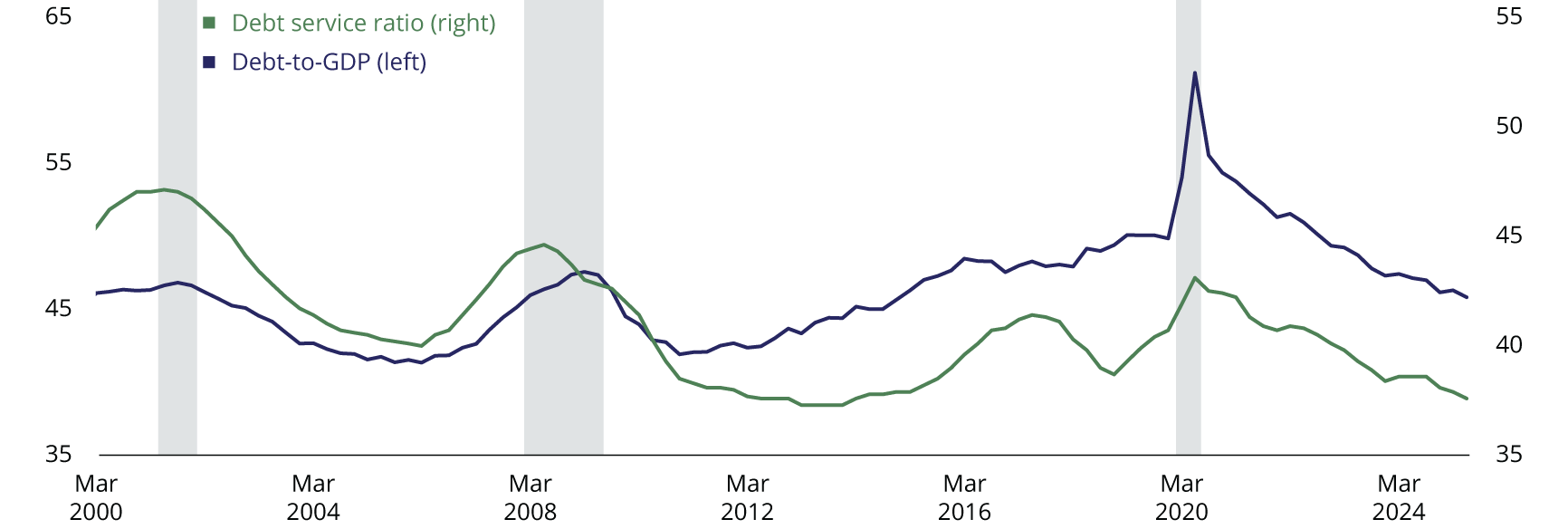
Note: Data as of June 2025. Shaded areas are U.S. recessions (NBER). The debt service ratio is debt payments divided by income.
Sources: Board of Governors of the Federal Reserve System, Bank for International Settlements, National Bureau of Economic Research, Bureau of Economic Analysis, Haver Analytics, Authors’ Analysis.
3. Commercial Real Estate: Underwater Loans and High Delinquencies
In 2025, the office real estate market continued to lag the broader commercial real estate market as companies’ office space needs remained below pre-pandemic levels. Delinquencies for office-based commercial mortgage-backed securities (CMBS) reached 11.1% in 2025. During this time, vacancy rates remained high but now appear to be stabilizing. Since 2020, office property prices have retreated roughly 8% or more in central business districts (Figure 2). Some mortgages are likely to be underwater, and further defaults may occur as maturity dates approach. However, commercial real estate (CRE) stress is less likely to cause financial instability because the riskiest mortgages are held by large lenders that include the largest banks, and these lenders are better able to absorb losses.
Figure 2. Commercial Real Estate Price Trends (indexes)
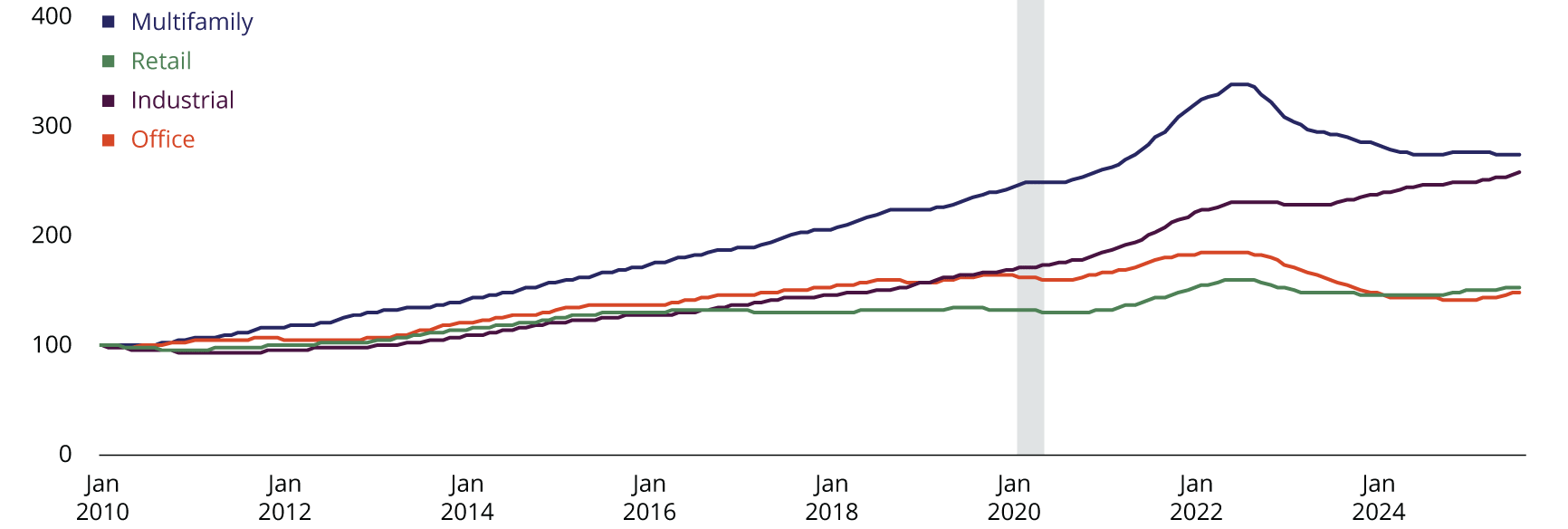
Note: Data as of August 2025. Shaded area is U.S. recession (NBER). December 31, 2009 = 100.
Sources: MSCI Real Capital Analytics, National Bureau of Economic Research, Haver Analytics, Authors’ Analysis.
4. Household Credit Stress: Student Loans and Subprime Borrowers
Total consumer debt remains elevated and has been a key economic growth driver (Figure 3). Subprime borrowers constitute over 14% of total households, according to TransUnion credit metrics, and have experienced increasing delinquencies across auto loans, credit cards, and other consumer financial products. These borrowers tend to face tighter liquidity constraints and greater sensitivity to inflationary pressures. Student loan borrowers have also faced additional pressure as student loan credit reporting resumed in late 2024. By mid-2025, more than 9 million borrowers, or more than 20% of all student loan borrowers, were delinquent.2 The broader economic implications are reduced household cash flow, impaired credit access, and increased vulnerability to income shocks.
Figure 3. Aggregate Nonhousing Consumer Debt ($ trillions)
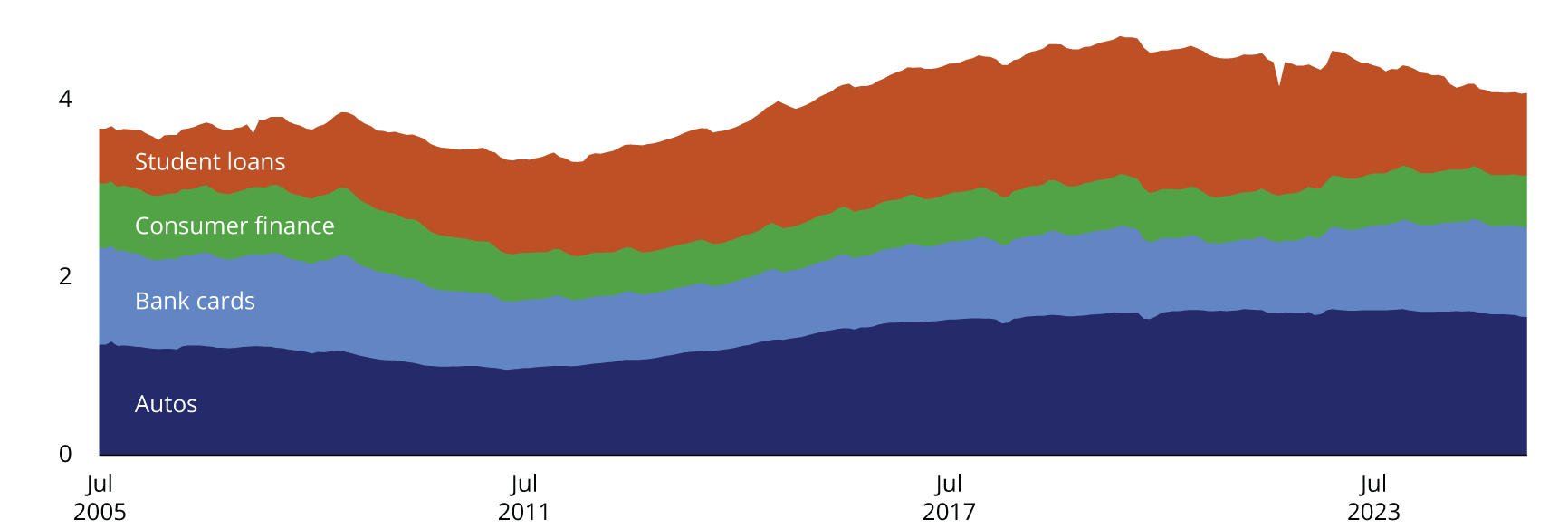
Note: Data as of August 2025. Amounts are adjusted for inflation using the July 2025 Consumer Price Index.
Sources: Equifax, Bureau of Labor Statistics, Federal Reserve Bank of St. Louis FRED, Authors’ Analysis.
5. Hedge Funds and Leverage Risk
Hedge fund activities can amplify market pressure due to their use of leverage. The industry has roughly $11.8 trillion in gross assets and is leveraged at 2.6 times. Some hedge funds that follow selected strategies, particularly macro, multi-strategy and relative value funds, are leveraged at 6 times; those funds with more leverage have a greater sensitivity to volatility and margin requirements. Hedge funds primarily rely upon repurchase agreements and prime brokerage borrowing (see OFR HFM Charts). In 2025, hedge fund repurchase agreement borrowing grew by 154% and prime brokerage borrowing by 83% since 2022 (Figure 4).
Figure 4. Hedge Fund Borrowing ($ billions)
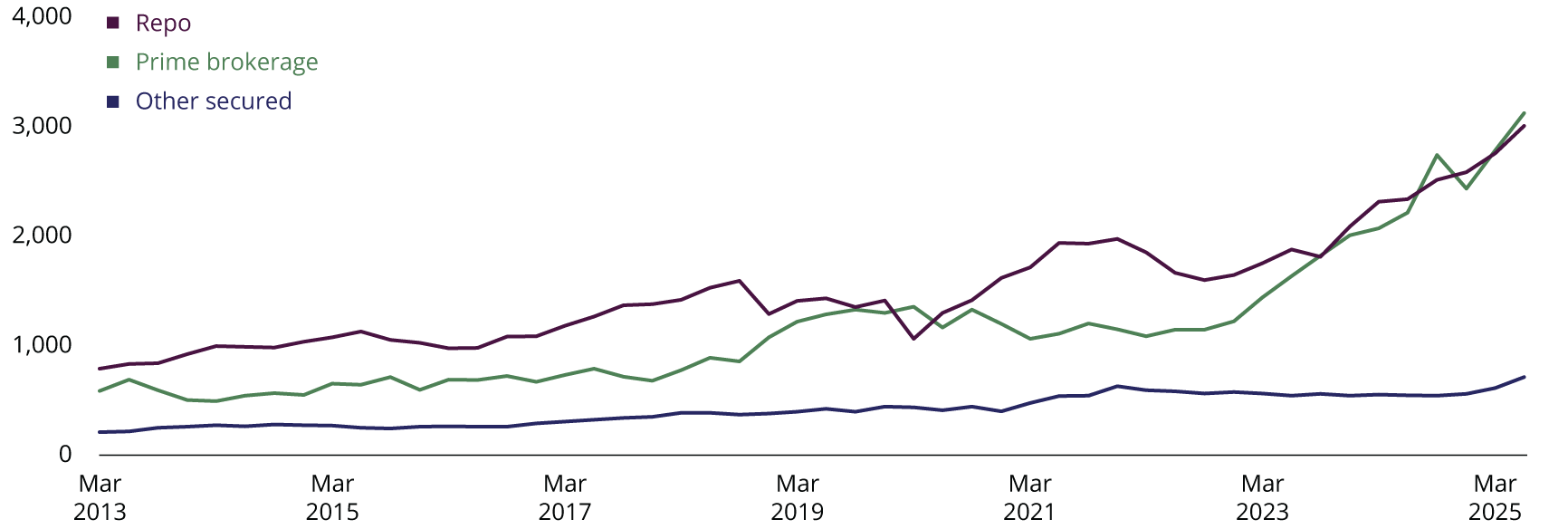
Note: Data as of June 2025. Data reflect only QHFs.
Sources: OFR Hedge Fund Monitor, Office of Financial Research.
Hedge funds also impact the U.S. Treasury market, as the industry holds sizable positions in Treasuries, futures, and related derivatives. While these institutions provide measurable liquidity to this vital market, a rapid unwind of their Treasury positions could add stress to this market and others. In 2025, the industry’s position increased by $1 trillion and reached an estimated $4.1 trillion, but volatility was noticeably tame.
The 2025 Annual Report details a financial system that is broadly resilient yet exposed to changing risks. Technology-related disruptions, rising household leverage, structural fragilities in short-term funding markets, elevated asset valuations, and the rapid growth of nonbank intermediation all contribute to a more complex risk environment. As these vulnerabilities evolve and others emerge, the OFR will continue to monitor them closely to identify emerging stresses before they spread more widely across the financial system.
-
Aya Wagatsuma et al., “Hackers Manipulate Markets in $700 Million Illicit Trading Spree,” Bloomberg, April 23, 2025. ↩
-
U.S. Department of Education, “U.S. Department of Education Delays Involuntary Collections amid Ongoing Student Loan Repayment Improvements,” press release, January 16, 2026. ↩